AI Builder · Owner-Operator · MBA in Business Analytics
I build AI that runs my business.
I taught myself to run AI that prices freight, tracks my books, and powers my MBA, and to run it privately, on my own machine, without handing my data to anyone. Every tool on this page came from a problem I hit running my own business.
Brownsville, TX · Bilingual (English / Spanish) · MBA in Business Analytics, 2027 · Open to Data / BI Analyst roles.
I didn't learn data in a classroom first. I learned it in a truck.
I've been behind the wheel since 2007, when I earned my CDL Class A.
For years I ran under my own authority, and because I'd always loved Excel, I started building what I'd call dashboards today: simple sheets that told me exactly what each load would pay after fuel and costs. That instinct to measure everything never left. In 2023 I moved my freight over to Landstar to cut the paperwork and focus on the driving and the building.
Then AI showed up, and I leaned all the way in. I taught myself where to go, how to code, and how to actually ship things. My crude spreadsheets became professional tools that show me what works and what doesn't, and I expand them every single day. Every problem I solve opens the door to the next idea, and chasing that next idea is the part I genuinely enjoy.
That's who I am: an operator who builds. I've spent 20+ years leading teams (a 20-year Army career, a 40+ member platoon) and grew my freight business from $100K to $300K in revenue with data-driven decisions. Now, with an MBA in Business Analytics, I look at any business the way I learned to look at mine: find where the hours and dollars leak, measure it, and build the thing that fixes it.
How I Work
I see businesses through an operator's eyes.
When I stepped into trucking and decided to buy my own truck, I made myself one promise: never stop looking for ways to improve the business. Chasing those improvements is where I picked up the ideas behind the automations and AI technology I use, and some of what I created along the way is on this page, live and working.
That habit changed how I look at every business, including mine. I don't see a mystery. I see processes that can be measured, decisions that can be sharpened, and hours that software can give back.
Find the leak
Every business loses hours and dollars somewhere. I learned to spot it because it was my money.
Measure it
Excel, SQL, Python. If it matters, it gets a number.
Build the fix
The proof is below: tools built for problems I lived.
What I've Built
Proof, not promises.
07 Newest Build
Flatbed Load Optimizer: The Load Plan Before a Single Pallet Moves
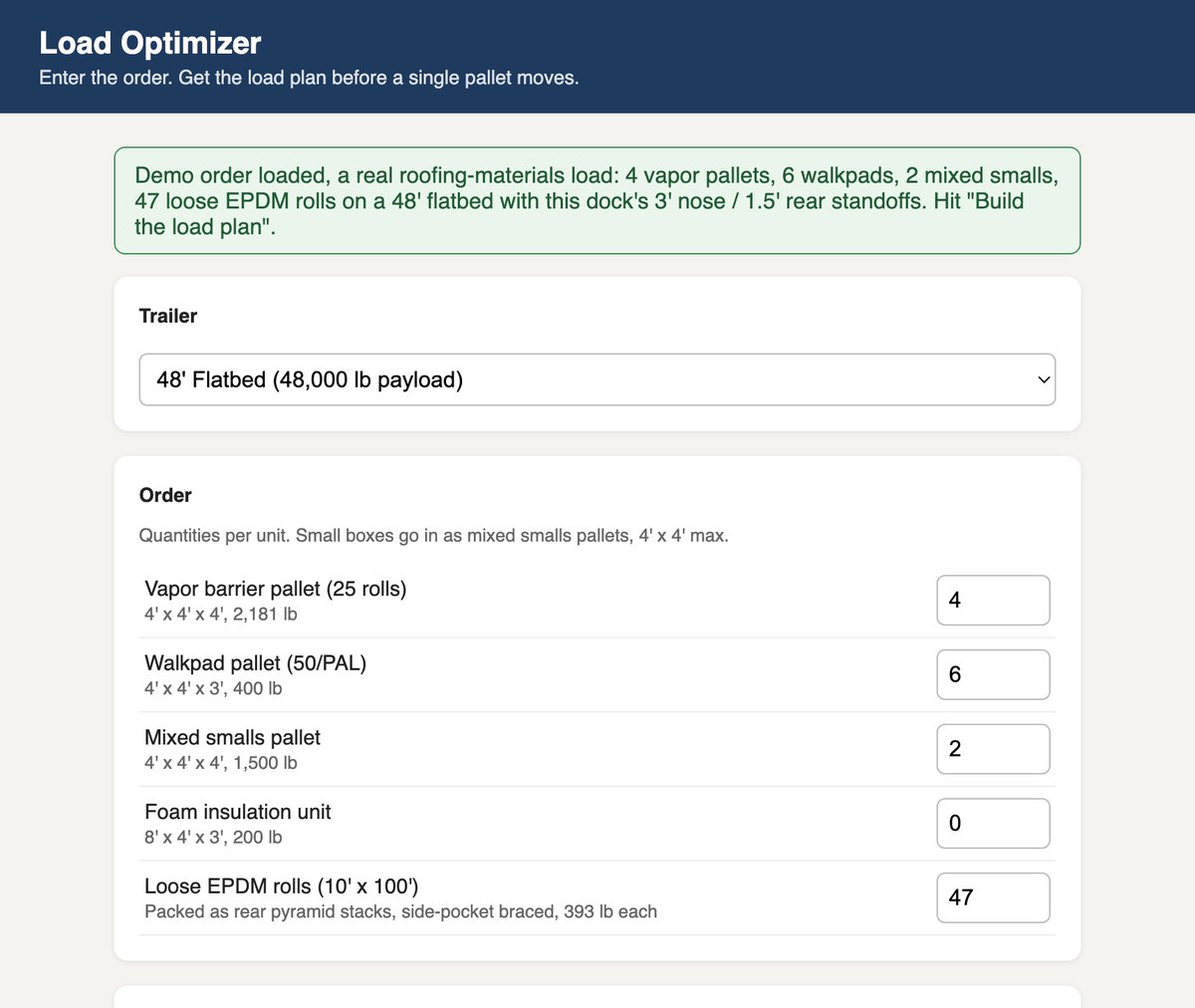
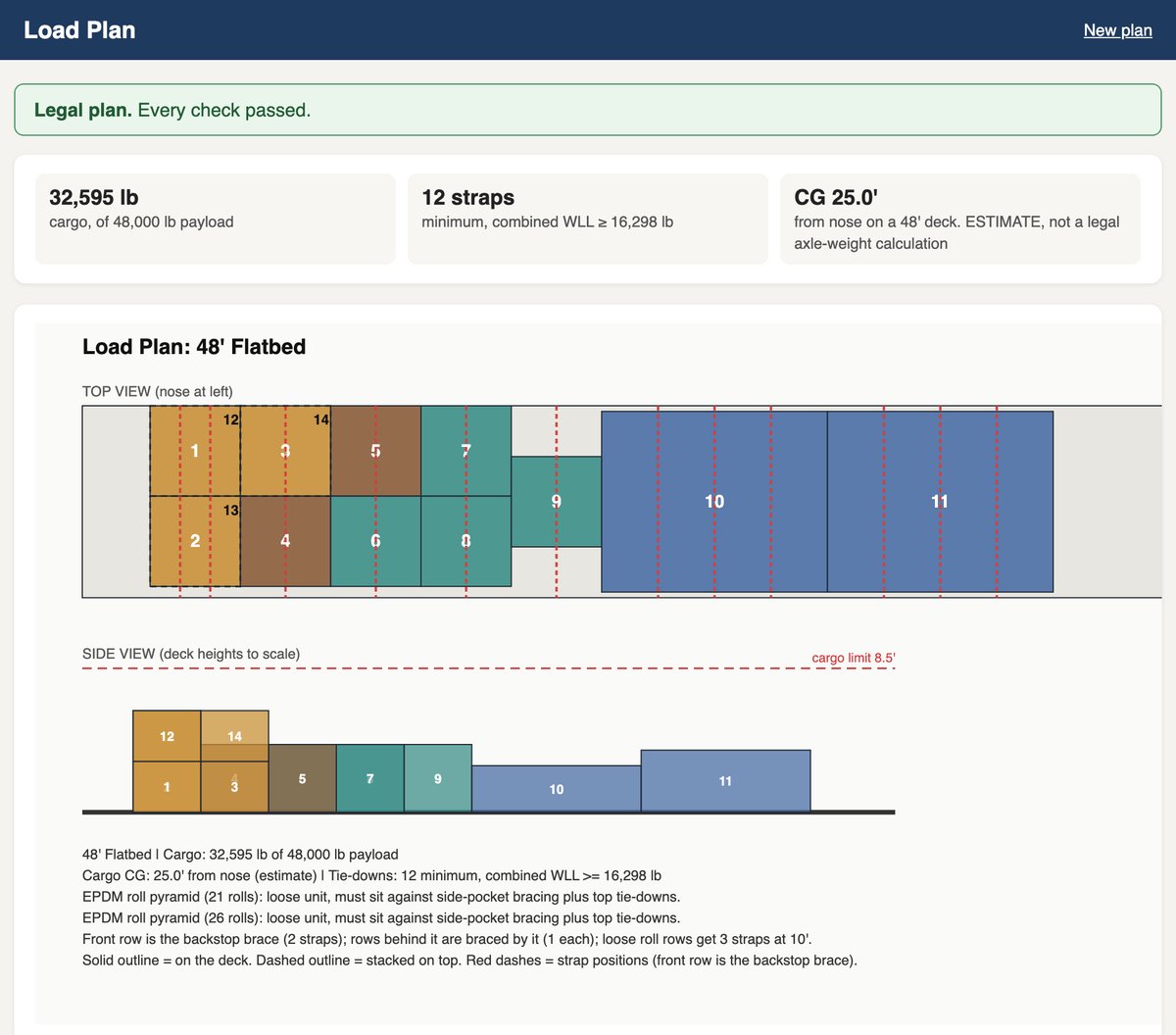
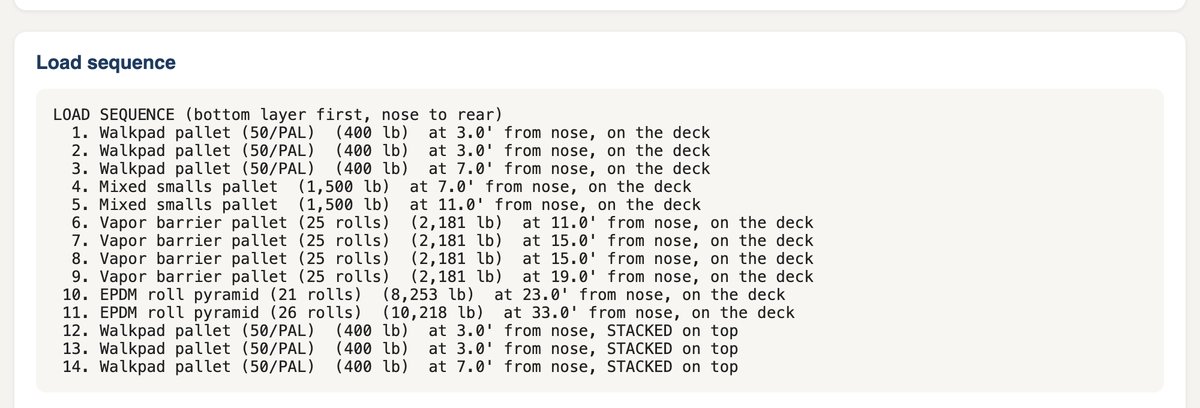
A web tool for shippers. The dock manager types in the order, picks the trailer, and gets back the complete load plan in seconds: a to-scale trailer diagram, the exact loading sequence for the forklift crew, strap counts by row, and weight and height checks, all before the first pallet leaves the rack.
Why it matters: I didn't find this problem in a dataset. I found it standing at the dock, watching a crew work out my load in real time. Nineteen years of flatbed experience, encoded into software a shipper can run. That's the kind of AI work I do: real operational pain, turned into a tool.
Step 1: The shipper enters the order. This is a real load I hauled: 12 pallets and 47 loose rubber-roofing rolls, plus this dock's own spacing rules.Step 2: The plan comes back. Top and side views of the trailer, 32,595 lb placed and centered, 12 straps specified, every legality check passed.Step 3: The crew gets a numbered loading sequence, nose to rear, bottom layer first. No guesswork at the dock.
Where the idea came from
I was picking up a flatbed load of roofing materials and watched the dock crew figure out the arrangement on the fly: what rides at the nose, what stacks on what, where the loose rolls go. All of that knowledge lived in people's heads. Get it wrong and you find out late, at the scale, at the strap check, or when freight comes back damaged. As the driver, I'm the one who straps it and hauls it legal, so I know exactly what a good load looks like.
What I built
A packing engine that knows the freight (pallet sizes, weights, what can bear weight, what crushes) and the rules of the road (payload limits, 8'6" height, center of gravity, strap working-load limits). It packs the trailer the way a good dock crew would: crush-sensitive foam at the nose, pyramid stacks of loose rolls braced at the rear, and the front row strapped as the backstop that braces everything behind it. Custom items can be added on the fly, and 34 automated tests keep the engine honest.
Why a shipper would pay for it
Every reload is forklift time, dock time, and driver detention. Every overweight or over-height surprise is a fine or a late delivery. This tool moves those mistakes from the dock, where they're expensive, to the screen, where they're free. It's the same playbook I used on my own business: find the spot where hours and dollars leak, then build the software that plugs it.
01
Hot Spots / Top Lanes Dashboard
A market-intelligence dashboard built off load-board data that shows where freight is hot and where to position for the next backhaul.
Why it matters: It's the tool I wished existed when I started driving. I built it for myself, and it guides where I actually point the truck.
For an MBA project I analyzed roughly 6 million shipments across air, rail, truck, and parcel, then determined the smartest mode by distance and shipment value.
Why it matters: Big data, real logistics stakes. Proof I can take millions of rows and turn them into a clear recommendation.
A team of AI agents that power my MBA work. They hunt down credible articles and documents for my research, so my assignments are built on the most accurate, current data. They also turn my reading into MP3s I can listen to while I'm driving, and I ask questions about what I'm reading through a chatbot from the road.
Why it matters: The research and the reading would have taken 10x longer without it.
06
Sales CSV Cleaner & Report Builder
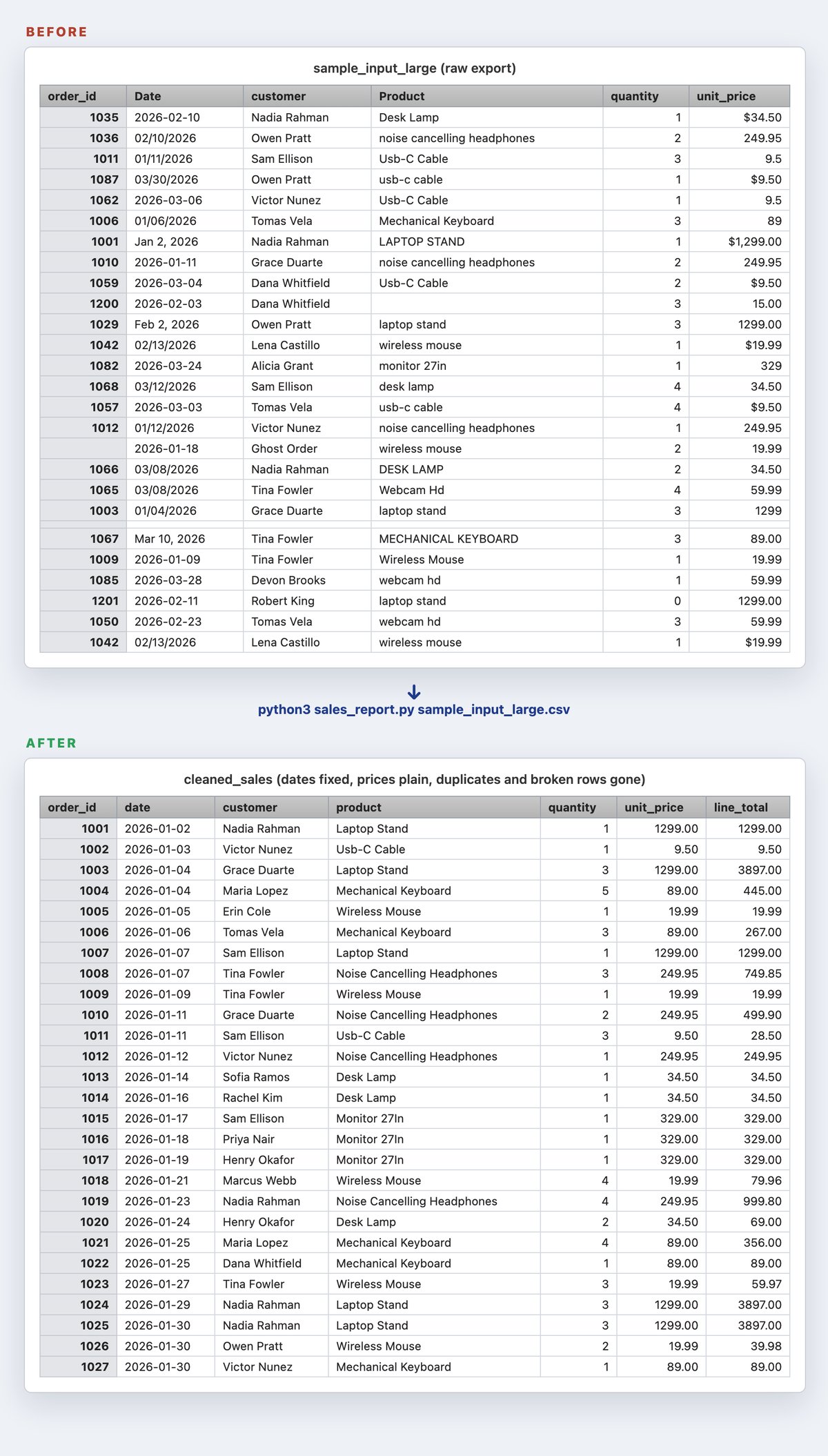
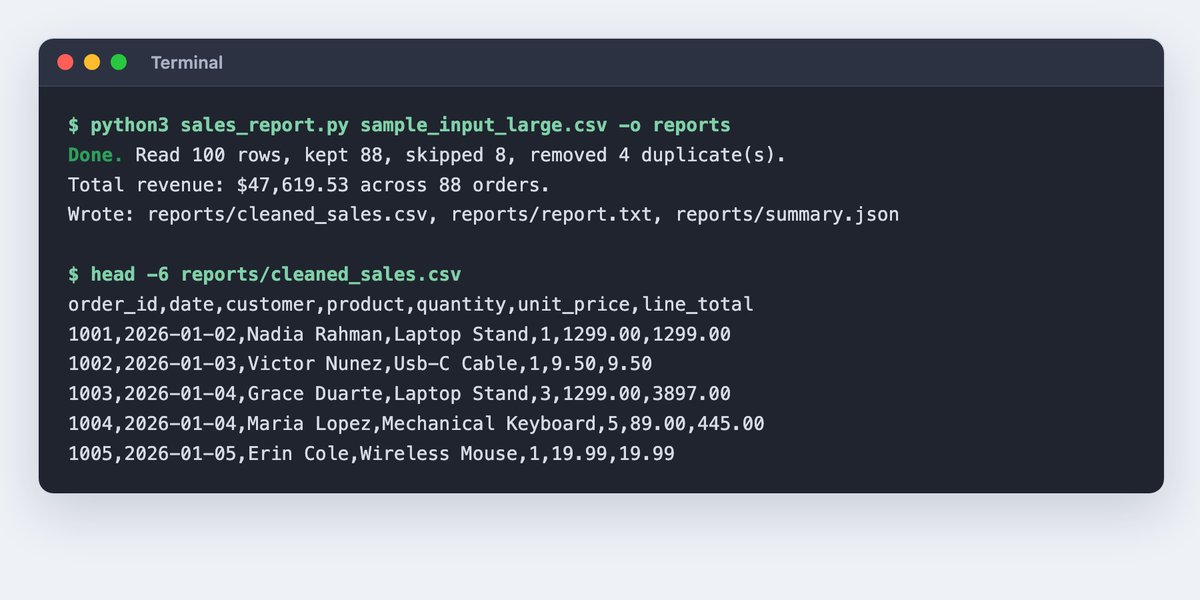
A Python tool that turns a messy point-of-sale export into clean data and a ready-to-read sales report with a single command. It standardizes mismatched dates and prices, drops duplicates and broken rows, and accounts for every row so nothing disappears silently.
Why it matters: It replaces an afternoon of manual spreadsheet cleanup with a few seconds of work, and produces the same trustworthy numbers every time. The quiet kind of automation a business runs every week.
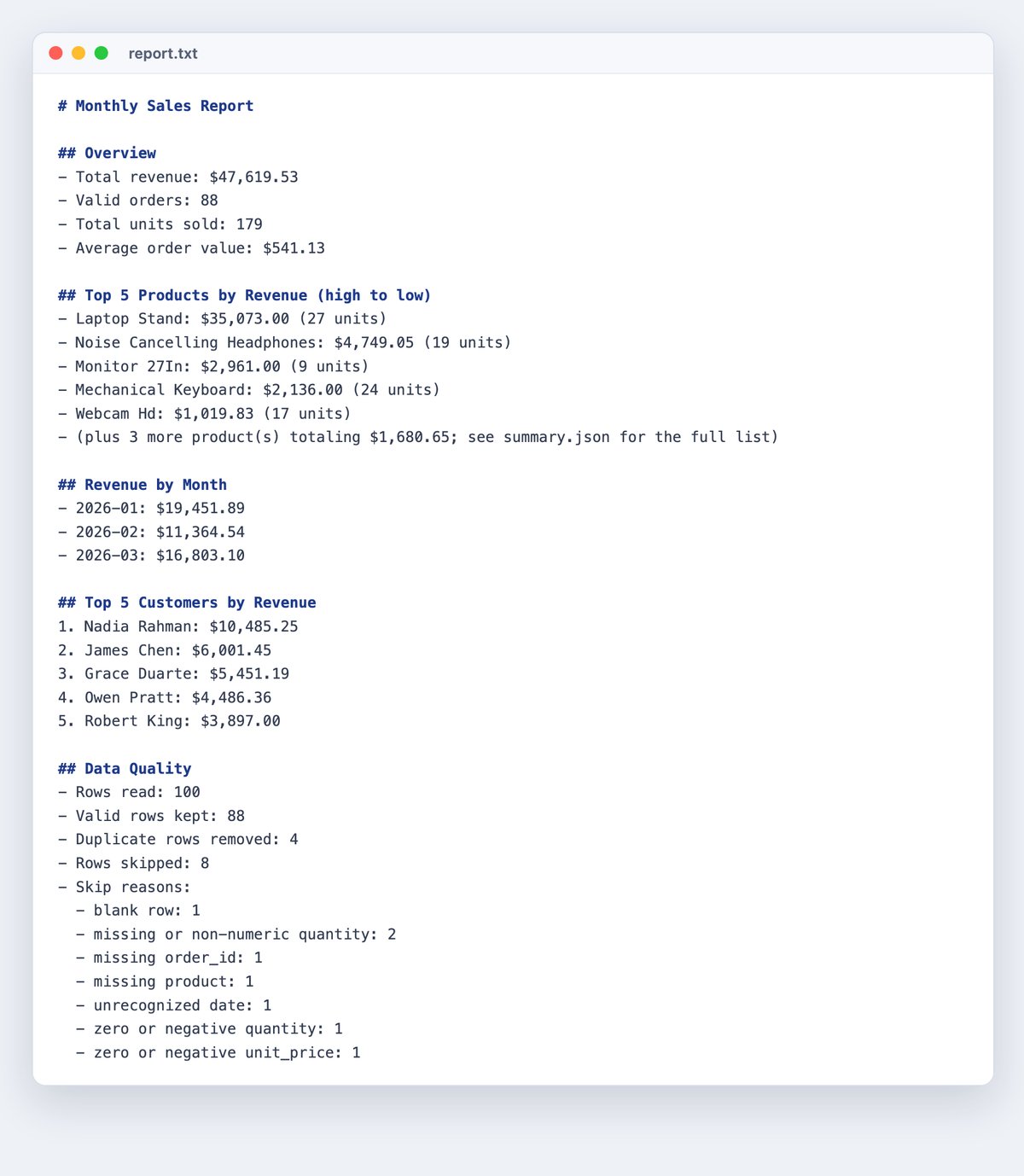
Step 1: Before and after. On top, the raw export: three date formats, prices as $1,299.00 and 1299, a row with no order ID, a blank row, a zero-quantity row, and a duplicate. Below, the same data cleaned and sorted, with a computed line total on every row.Step 2: One command. 100 rows read, 88 kept, 8 skipped, 4 duplicates removed, and the cleaned file comes out tidy with a computed line total.Step 3: The report. Revenue by product and month, top customers, and a data-quality section that explains every single skipped row. Nothing disappears silently.
What it is
A lightweight Python tool that takes the raw, messy CSV a point-of-sale system exports and turns it into three usable files. It runs on the Python already built into your computer, so there is nothing to install and no monthly fee.
How it works
You run one line and point it at your export. It standardizes every date format, strips the dollar signs and commas off prices, tidies product names, removes duplicate orders, and pulls out broken rows (missing IDs, bad dates, zero prices). Then it hands you back a clean CSV, a plain-English report (revenue by product, by month, and top customers), and a machine-readable JSON.
Why it saves time
What used to be an afternoon of copy-paste and find-and-replace becomes seconds. Every row is accounted for (kept plus skipped plus duplicates removed always equals rows read), and the report tells you exactly why anything was dropped, so you can trust the revenue figure. Build it once, reuse it forever.
Let's talk.
Want to talk about a data role, or about anything I've built? I'm easy to reach.